

If you’re a rental property owner in Grand Rapids, one of the first questions you might ask when considering whether you want to hire a property manager or self-manage your property is, “How much does a property manager cost?”
The average property management fee in Grand Rapids typically ranges from 8%–10%. However, the exact amount depends on many factors, including the company, the services included, and the type of property being managed. While many landlords primarily focus on the monthly management fee, it’s important to understand the full cost structure and, more importantly, what services you’re receiving for that fee.
In this guide, we’ll break down the typical property management fees in Grand Rapids, explain what services are usually included, and help you determine whether professional property management makes sense for you and your rental property.
Typical Property Management Fees in Grand Rapids
Most full-service property management companies charge three primary fees: monthly management fees, tenant placement fees, and lease renewal fees.
1. Monthly Management Fees
The monthly management fee is the recurring fee charged for handling the day-to-day operations of the rental property. We’ll discuss more about the standard services typically included later in this guide.
In Grand Rapids, most companies charge between 8% and 12% of collected rent, with some companies either offering a flat-fee pricing model instead of a percentage or in addition to a percentage option.
Example (Using a 10% management fee*):
- A 10% management fee on a property renting for $1,200/month = $120/month
- A 10% management fee on a property renting for $2,000/month = $200/month
*Actual pricing varies by company.
Some companies charge the management fee regardless of the occupancy status of the property, while others may only charge it when rent is collected. It’s important to ask prospective property management companies how vacancies are handled before you sign a management agreement with them.
2. Tenant Placement Fee
When a property becomes vacant, management companies typically charge a placement fee to market the property, conduct showings, screen applicants, prepare lease documents, and coordinate a move-in. Some companies may also call this a leasing fee.
In the Grand Rapids market, you can expect to see placement fees ranging from 50% to 100% of one month’s rent, with many companies falling closer to 65% to 75% of one month’s rent.
3. Lease Renewal Fee
Most management companies also charge a fee when renewing an existing tenant’s lease. You might ask yourself why there’s a fee when there’s no need to perform all of the tasks involved with finding and placing a tenant, but there’s still work to be done before and during a lease renewal.
Renewal services often include:
- Tenant eligibility review
- Market rent analysis
- Renewal negotiations
- Compliance updates
- Lease preparation
- Obtaining required signatures
Common renewal fees range from $200 to $500, although some companies may also advertise a percentage-based fee.

Other Fees to Watch For
One of the biggest mistakes landlords make is comparing management companies based only on the monthly fee without understanding what’s included and what other recurring fees will be charged.
For example, some companies advertise a lower monthly management fee to present as more appealing on the front end, then charge additional fees for services that might already be included in the monthly fee elsewhere.
Some fees that you may want to ask about include:
- Maintenance coordination fees
- Project management fees
- Property inspection fees
- Eviction coordination fees
- Utility management fees
- Startup fees
As mentioned above, make sure you’re comparing the complete fee structure and costs when comparing management company fees and structures to ensure you’re comparing apples to apples. A company with a slightly higher monthly fee may actually cost less overall if more services are included in the cost.
What Does Full-Service Property Management Include?
While every company is different, most management services include the following in the standard management agreement and monthly management fees:
Management & Leasing Services
- Rent collection
- Lease enforcement
- Tenant communication
- Delinquency follow-up
- Fair housing compliance
- Legal notices
- Security deposit collection, holding, and disposition
Maintenance Services
- Maintenance request coordination
- Vendor coordination
- Emergency maintenance
- Repair approvals
- Invoicing and payment processing
Financial Services
- Monthly owner statements
- Year-end tax documents
- Online owner portals
- Expense tracking
How United Properties Compares
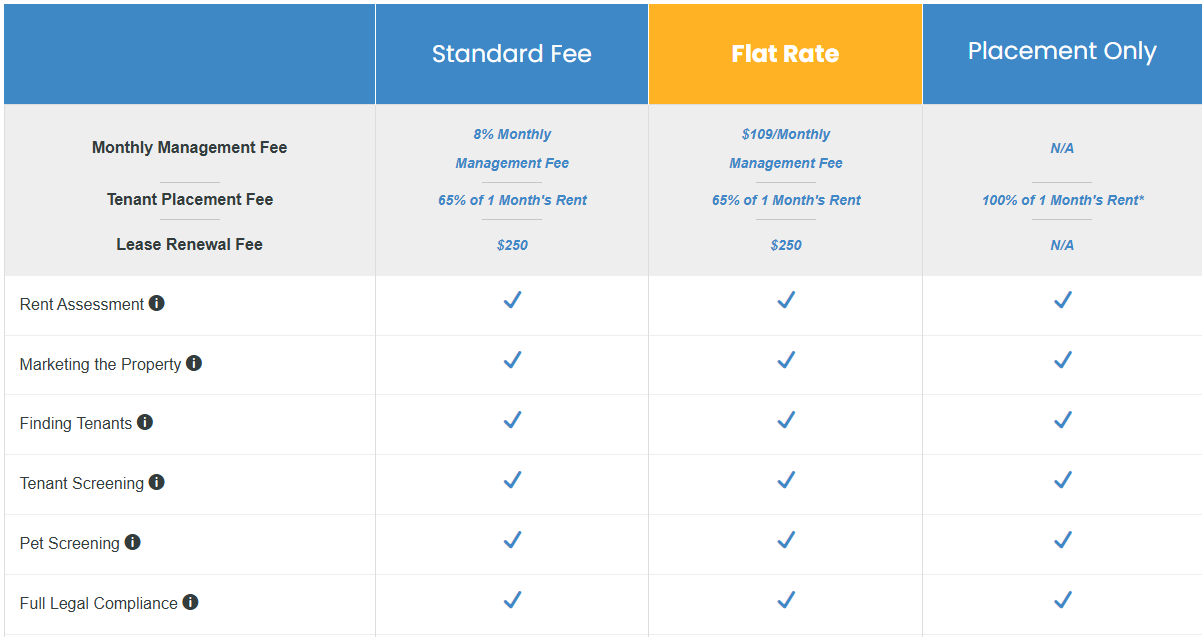
Among the highest reviewed in Grand Rapids, United Properties offers a variety of pricing structures for our owner clients, including a choice of flat-fee or percentage-based pricing, as well as multi-unit discounts for rental property owners who sign on 10+ units to management.
See our basic pricing breakdown below:
- Monthly Management Fee: 8% or flat $109
- Tenant Placement Fee: 65% of one month’s rent
- Renewal Fee: Flat $250
Depending on what you expect or anticipate your property renting for, you can choose which pricing structure works best for you.
Example One: In this first example, the 8% management fee would be more cost-beneficial to the property owner.
Rent: $1,200
8% Management Fee = $96
Flat-Rate Fee = $109
Example Two: In this second example, the flat-rate fee would be more cost-beneficial to the property owner.
Rent: $1,400
8% Management Fee = $112
Flat-Rate Fee = $109
Is Property Management Worth the Cost?
Self-managing their rental property works well for many landlords, but the assistance of a professional property management company becomes valuable when they begin experiencing challenges such as:
- Late-night maintenance calls
- Difficult tenant situations
- Rent collection issues
- Vacancy management
- Incorrectly priced rental
- Legal compliance concerns
- Limited time availability
Those challenges can shift the mindset from “How much does property management cost?” to “What is the cost of not having a property management company?”
Consider the financial impact of:
- One month of vacancy
- Placing a poorly qualified tenant
- Mishandling a security deposit
- Fair housing violations
- Rent collection delinquency
- Eviction
Landlords often discover that avoiding just one major mistake or mishap can offset years of management fees.
When Professional Management Makes Sense

Property management is a strong fit for most landlords, but it can be especially beneficial for the following rental property owners.
Out-of-State Owners
If you’re not located near your property, having local professionals with knowledge of the market and on-staff office staff and maintenance technicians is invaluable to both the owner experience and the tenant experience.
Busy Professionals
Most rental property owners aren’t landlords full-time. While yes, the job never stops, landlords often have full-time “day” jobs outside of owning and managing their rental properties. Because of this, landlords often find that they don’t have the time to handle leasing, maintenance, and tenant communication in addition to other life demands and stressors.
Growing Investors
As portfolios expand, systems become increasingly important. Professional management companies can help investors scale without becoming overwhelmed by the never-ending demand of owning and managing rental properties.
Accidental Landlords
These are landlords who inherited a property, relocated for work, or decided to rent rather than sell, and they often find that professional management helps reduce both the stress of self-managing and the risk, especially for those who never planned or intended to become landlords.
Final Thoughts
While cost is certainly important, the value provided is even more important than the fee itself. When evaluating management companies, look beyond the monthly cost and consider:
- Included services
- Communication standards
- Maintenance processes
- Tenant placement strategies
- Fee transparency
- Local market expertise
The best property management companies should not just collect rent, they should also help protect your investment, preserve your time, reduce risk, and maximize your long-term returns.
When you’re researching your options, ask plenty of questions to help you find the management company that delivers the best overall value based on your individual needs, your property, your desired level of involvement, and your long-term investment goals.
Thinking About Hiring a Professional Property Manager?
If you’re currently self-managing and wondering whether professional management makes sense for you and your property, we’d be happy to talk with you, provide a no-obligation rental analysis, and discuss your options to determine whether we’re a good fit for you and your goals!
Whether you own one rental property or an entire portfolio, understanding your costs and opportunities is the first step toward maximizing your investment.

 Eden joined United Properties in 2016. Eden graduated from Davenport University in 2015 with an Associate’s in Business Administration. She’s the Executive Assistant to the Owner of United Properties, with a focus on procedural documentation. She enjoys playing guitar, reading, and doing outdoor activities. Eden is trilingual and able to communicate in English, Spanish, and American Sign Language.
  David joined the United Properties team in 2019 as the Director of Client Relations and Business Development. In this capacity, he is responsible for leading all leasing, application underwriting, tenant relations, accounts receivable, process improvement, remote workers, and general office functionality (essentially anything outside of maintenance and service). David comes from a longstanding career at a Fortune 15 company primarily in a sales and customer service leadership role.


 Cristina joined United Properties as the Accounting and Billing Team Lead in October of 2020. She has experience as a technology professional, an English-Spanish translator, and has worked the past several years as the treasurer of her condominium.
 Rick joined United Properties in 2020 as a Service Coordinator and then later transitioned to the Collections team, where his customer service shines. Rick has an extensive background in customer service and enjoys being able to resolve issues. He and his wife are raising their two kids and in his free time, Rick enjoys making his own homemade jerky.
 Harriet joined United Properties as a Accounting & Billing Specialist in February of 2021. She has experience as a bookkeeper and a Property Manager for a Real Estate account. She was a working student during her college days. Harriet loves cleaning because she thinks it is therapeutic. She also loves watching series during her free time, and she’s a fur mom of one dog. Her inspiration to work every day is her family.
 Diego has an extensive background in customer service and, most recently in Maintenance and
 Paulina joined United in early 2021 as a Leasing Assistant. She has a background studying social work, with several years of experience in customer service. She speaks English and Spanish fluently and loves to learn. Paulina enjoys small road trips and cold, rainy weather. Her dog is her favorite thing in the world.
 Jessica has a Bachelor’s Degree in Financial strategies and public accounting and is studying a masters in Blockchain and Fintech regulation. She has previous experience as a customer service representative. She speaks English and Spanish. She loves taking long walks with her three dogs, hiking and road tripping during the weekends.
 Chris Good is new to the United Properties Team since June 2022 as a Business Development Manager. With years of experience in both the construction industry (Master Electrician) and the Real Estate industry (Broker), he will closely work with new and experienced investors to facilitate their real estate goals.


 Enrique Vergara (Henry)
 Alyssa Conklin



 Soroya has been with United Properties since March 2025. Her problem-solving, time management, and communication skills help her shine when working collaboratively with tenants and prospects. She is currently pursuing a degree in Cyber Security at Davenport University. Thanks to her tech-savviness, she excels at navigating and troubleshooting common technology and software issues.
 Marlon Joined United Properties in 2025 as a service coordinator. He arrived with solid experience in customer service, property management, and marketing. If you need assistance with either a new or a previous situation, he will be more than glad to help you. Depending on the season, he likes spending time outdoors, going hiking, or simply taking a stroll around town to see what’s new in the city.
 Hector began his career in customer service in 2017, gaining valuable experience in client support and communication. In 2021, he transitioned into sales roles, where he developed a strong ability to drive results and build relationships. Since 2023, he has worked in maintenance, IT, and tech support, expanding his skills in troubleshooting, systems support, and hands-on problem-solving. His background combines over eight years of customer-facing roles with a growing expertise in technical support and operations.
 Gar Allison joined United Properties as Director of Operations in August 2025. He brings a decade of experience, covering construction project management, supply chain, sales, marketing, and regulatory compliance. Before that, he spent five years as an Engines Sales Representative in Kansas City, MO, shortly after graduating from Davenport University in 2011 with a bachelor’s degree in business management.